
Translations from English to German
English in, German out
It’s as simple as that – at least if you want to believe the marketing departments of major machine translation platforms. Just enter your source text and ta-dah! There’s your high-quality translation! The company behind DeepL even claims their tool was “the world’s most accurate translator.” That’s pure hype, of course, and you can easily see this on DeepL’s website, which is filled with 1:1 translations. Further below, I show you examples for typical errors made by MT systems, but even if you only speak English and can’t assess other language versions of DeepL’s site, just look at all those boring buzzwords, from “personalized experiences” to repetitive promises of “transformed business communications.” Does this sound like high quality to you?
Machine tools certainly have their place in modern business environments and can speed up workflows if used in suitable scenarios with realistic expectations. If you do want to employ such systems and need assistance with evaluating and polishing their output, I’ll support you with various MTPE services.
For all your human translation needs, the following sections provide important information to help with your scheduling and budget planning.

Overview
- What?
- Translations from English to German
- Confidentiality and quality assurance
- Focus fields: IT, media, marketing
- Other fields: travel/tourism, consumer goods, T&Cs, manuals, business/general correspondence
- How?
- With CAT tools such as Trados Studio, memoQ
- Or on platforms such as Phrase, XTM, Lokalise
- Use of “AI”/LLMs requires explicit agreement
- All common file types: MS Office, LibreOffice, ODT, PDF, RTF, HTML, XML, PHP, JSON, XLIFF, IDML, etc.
Major steps in a translation project
Ideally, your initial project request should already include key details such as your text’s topic and scope (for example, word count, number of standard pages or video length for subtitling), desired delivery date, file format, and any other individual wishes if applicable (such as your preferred terminology or localization platform to be used). Don’t rack your brain, though, if you’ve never ordered translation services before – should I require more details and information, I’ll ask.
The next steps depend on the type of project. For single tasks with clear requirements, you now need to send me the text to be translated. I’ll provide you with a non-binding quote, and as soon as you confirm it, I get started.
For large projects with staggered delivery or special requirements, we’ll first discuss all details (either via e-mail or, if suitable, via Slack/Zoom/phone), and then I’ll also provide you with a non-binding quote. Usually, there’s no need for any framework contract or retainer fee, but in some cases it might make sense to agree on a guaranteed minimum order volume per month as this will result in cost savings for you.
You’ll receive the completed translation in your desired file format by the agreed delivery date. If you’re going to do any sort of further formatting or copying and pasting on your end (for example, when publishing the translation on your website or inserting it into your Figma designs), I’ll be happy to take a look at the final version to make sure no typos or errors were introduced during these additional steps.
By the way: In contrast to machine tools, human translators thoroughly read and understand your source material. When doing so, I sometimes spot typos or inconsistencies that you may have overlooked. In this case, I’ll either let you know while working on the project or I’ll include some delivery notes with my translation that’ll help you make the necessary corrections.
These numbers refer to the average amount of words that can be translated within the respective time interval. Please, use them as general guidelines that apply to continuous text of standard difficulty in my working fields and language combination.
How much does the translation cost?
Various factors affect the costs of translation projects. How long is your text? In which format do you have it? How soon do you need the translation? And is there enough context or does the task comprise just individual words or phrases that’ll require cumbersome research to determine what it’s all about?
Depending on the type of project, I charge either per source word or per hour. My standard rates are €0.10 per word and €50 per hour, respectively. Special requirements, such as formatting and additional proofreading, or very urgent tasks will usually incur higher costs.
Two examples: Client A has a simple company presentation with about 2,500 words, available as a Word file, that needs to be translated within two weeks and delivered in the same file format. Client B is about to launch a new mobile app and spontaneously decides that it should be available in multiple languages right away. The menus and other in-app content add up to about 4,000 words and can be accessed as individual strings on an online localization platform. The app is expected to launch the day after tomorrow. In other words: chop-chop!
I’m sure you can figure out which of the two clients will have to pay more. These examples also illustrate how you can lower your costs. Book my services early to avoid weekend surcharges and rush fees. Consider whether a very long document really needs to be translated in full – maybe it’ll suffice to translate only an executive summary or shortened version that would still serve the purpose and audience? And if you need individual strings or fragments translated for a website or app, sending me a couple of screenshots or links for context will go a long way. I’ll spend less time with research, and you’ll spend less money!
Payment Terms
Clients in Germany or other countries in the Single Euro Payments Area (SEPA) can make payment via simple credit transfer. For all other clients, I currently offer PayPal as an alternative option. My standard payment terms are 14 days, and my Terms & Conditions apply.
Should you require different payment options, I’m open to suggestions. Any deviations from my standard terms need to be agreed in writing before I begin work on your project. If you have further questions or would like to place an order, my contact form is all ears!
Human vs. machine
As mentioned above, machine tools sometimes do deliver acceptable results. When using such tools, consider the following guideline: The simpler your text and the lower the risk and potential damage due to mistranslations, the more likely it is that some form of automation can be applied. Damage, in this case, means any financial losses or legal disputes as well as damages to your image and reputation. A customer might still be able to use your product despite a botched translation of its user manual – but when that customer is ready to make another purchase, they’ll probably check out your competitors who put in more effort.
On my MTPE Services page, you can find more details regarding the types of documents that are suitable for machine (pre-)translation. Below I’m showing you some examples for typical problems that arise when relying on machines. These excerpts are taken from projects where clients had activated a machine translation tool to help me. They meant well, but unfortunately those tools didn’t add much value.
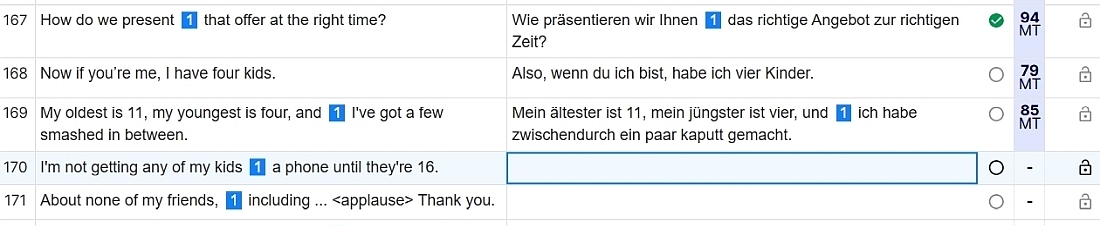
This first example shows part of a keynote speech in rather colloquial style, which was to be translated on the localization platform Phrase. The client’s “AI” system of choice was Amazon Translate. Now, as you can see in lines 168 and 169, the speaker is talking about his four kids. He mentions his oldest, his youngest, and the other two “smashed in between.” Smashing something can also mean breaking things, and this type of ambiguity causes problems for machines. Amazon’s “AI” chose the translation, “ich habe zwischendurch ein paar kaputt gemacht.” Maybe you don’t speak German but are wondering whether “kaputt” and “kaput” are related? You’re right! The machine translation claims that the speaker destroyed some of his kids. Ouch!
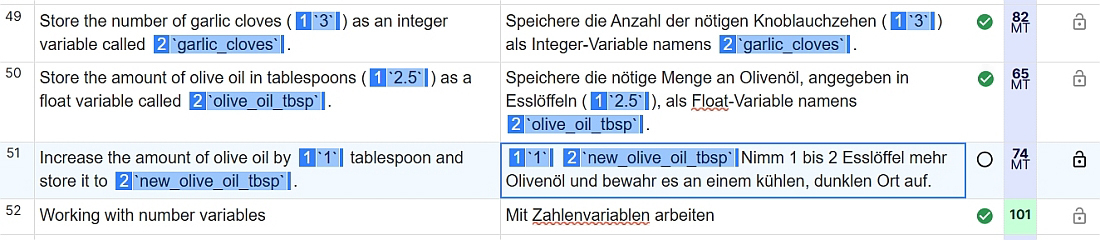
The second example from an e-learning course is related to a computer program that can save recipes and store ingredients in variables. This client also used Phrase but opted for DeepL’s machine translation tool. And believe it or not, “the world’s most accurate translator” failed on multiple levels. The blue tags in line 51 are in the correct position in the source sentence but uselessly sit at the beginning in the target segment where they do not belong. While the source talks about 1 tablespoon of olive oil, the target requires 1 to 2 tablespoons. And on top of it all, DeepL then explains how to properly store olive oil (“an einem kühlen, dunklen Ort” – in a cool, dark place). I mean, thanks for the advice, but it’s not in the source text at all!
These are typical errors made by Large Language Models (LLMs) due to them calculating their output based on probabilities and biased training data. You can and should mitigate against risks, but it won’t change the fact that these systems do not actually understand your text.
Frequent Questions
If your question isn’t answered here, please, also check my FAQ page or drop me a line via my contact form. Thanks!
Will all texts and files be treated confidentially?
Of course! Whether it’s an internal business memo or your new novel’s exciting plot, I’ll handle your sensitive data with care. If you publish a finished translation of mine (for example, texts for your website), I’ll reserve the right to include that project in my portfolio, but even in this case I will not disclose any sensitive information. And whenever I use examples from specific projects for illustration purposes (as seen above in the “Human vs. machine” section), I only use fragments that either have been published already or do not clearly identify any client.
Are the translations notarized?
No. In my working fields, notarized translations are rarely required, which is why I don’t offer this service at all. If you do need a notarized translation of certificates, diplomas or similar types of documents, you can browse the Database of Translators and Interpreters of the German state justice administrations to find a qualified language professional.
Are the prices negotiable?
In general, (almost) everything is negotiable as long as we’re talking about reasonable and fair requests. In this regard, the translation sector is no different than other industries. The larger your order, the faster your payment, and the more flexible your deadline, the more likely you’ll fall on sympathetic ears. However, keep in mind that translations aren’t assembly-line products. Economies of scale, as in the mass production of consumer goods, are rarely achievable. Time and cost savings primarily result from getting regular projects dealing with similar topics so I won’t have to start from scratch with every new task.
Plus, some topics or types of projects are so enjoyable that work doesn’t feel like work at all. This keeps me in good spirits, and I’ll be happy to return the favor in the form of discounts or other extras. Thus, even if your budget is tight, drop me a line anyway to discuss what’s doable.